
Tilt-Rotor Kamikaze Drone – Loitering Munition UAS
BLA1000XSERIES Tilt-Rotor Kamikaze Drone-Loitering munition UAS
Tilt-Rotor Kamikaze Drone-Loitering munition UAS
Introduction – General Description
The loitering capability enables the UAV to remain airborne over a target area and strike at the optimal moment, enhancing mission precision and minimizing collateral damage.
Combining portability, speed, lethality, and ease of use, this UAV offers an efficient and rapidly deployable solution for precision tactical missions on the modern battlefield.
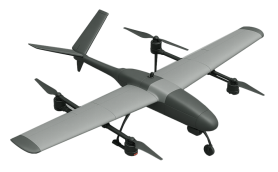
The Tilt-Rotor Kamikaze Drone – Loitering Munition UAS is a lightweight, compact, and fast unmanned aerial system specifically designed for immediate elimination of critical threats and support of tactical operations with high lethality, precision, and low cost. Its portable design, vertical take-off and landing (VTOL) capability, and rapid deployment by a single operator allow it to be used in any operational environment without the need for runways or specialized infrastructure. It is equipped with a 3–4 kg warhead, suitable for the destruction of high-value targets (HVTs), anti-armor operations, suppression of hostile threats, and support of special forces.
Main Features
- Vertical Take-Off and Landing (VTOL): Allows rapid deployment in any operational setting, even without infrastructure.
- Loitering Capability: Ability to hover at a set altitude and position for a defined time before executing a strike.
- Portable Design: Small size and weight, transportable by a single operator, ready for launch within minutes.
- 3–4 kg Warhead: Capable of targeted strikes against vehicles, lightly armored targets, personnel, and critical infrastructure.
- Autonomous or Manual Navigation: Supports fully autonomous missions or operator-guided control for maximum flexibility.
- EO/IR Targeting System: Electro-optical and infrared sensors for day/night identification, targeting, and tracking in real time.
- Low Cost – High Lethality: Ideal for kamikaze missions with minimal investment and maximum effectiveness.
- Rapid Deployment – Immediate Response: Launch-ready within minutes of receiving an order.
Detailed Technical Characteristics
Structure and Build
UAV Type: Tilt-Rotor Loitering Munition – Kamikaze drone with loitering and target-strike capability
Material: Lightweight composite materials (CFRP) for strength and low weight
Design: Portable, compact, field-assembled by a single operator
Operation: Autonomous or operator-guided
Dimensions and Weight
Length: ~1.8 meters
Wingspan: ~2.20 meters
Maximum Take-Off Weight (MTOW): ~15–18 kg
Payload (Warhead): 3–4 kg
Propulsion System
Engine Type: Electric – Silent and low signature
Power Source: High-performance LiPo batteries
Loitering Time: Up to 25 minutes at a set altitude and position
Flight Performance
Endurance: 45 minutes in loitering mode
Mission Range: Up to 40 km (depending on the mission)
Cruise Speed: ~95 km/h
Maximum Speed: ~120 km/h
Operational Altitude: Up to 2000 meters
Payload Capacity
Warhead: 3–4 kg with potential anti-armor capability
Sensors: EO/IR camera for real-time targeting and tracking
Operational Applications
The Tilt-Rotor Kamikaze Drone – Loitering Munition UAS is a versatile, portable, and rapidly deployable system designed for immediate elimination of critical threats and support of precision tactical operations on the battlefield.
Thanks to its portable design, it can be easily transported by a single operator and quickly assembled and launched within minutes, making it ideal for missions in confined or remote areas without infrastructure or heavy equipment.
The UAV supports multiple mission types tailored to the needs of the modern battlefield:
Military Missions
- Elimination of High-Value Targets (HVTs): Destruction of enemy command posts, vehicles, radar systems, and anti-aircraft defenses.
- Suppression of Enemy Air Defenses (SEAD): Accurate strikes on critical targets with minimal collateral damage.
- Special Forces Support: First-line tool for immediate strikes in complex operational environments.
Tactical Precision Operations
- Targeted Attacks with 3–4 kg Warhead: Capable of destroying armored vehicles, light fortifications, and critical infrastructure.
- Loitering Capability: Remains over a defined area for up to 25 minutes, executing the strike at the optimal moment.
- Reduced Collateral Damage: Thanks to a small warhead and accurate targeting via EO/IR sensors.
Tactical Forces Support
- Portability and Rapid Deployment: Carried by a single operator and quickly deployed in any operational environment.
- Autonomous or Manual Operation: Supports fully autonomous missions or operator-guided control for maximum flexibility.
- Intelligence Collection and Targeting: Integrated EO/IR sensors provide target recognition and real-time tracking before execution.
System Advantages
- Portability and Rapid Deployment: Designed for easy transport by a single operator and fast battlefield deployment without infrastructure or heavy equipment.
- Vertical Take-Off and Stable Flight (VTOL): Enables operation from confined spaces, without runways, with full deployment flexibility.
- Loitering Capability: Ability to hover over a target area for a defined period, allowing precise timing of the strike.
- 3–4 kg Warhead: Capable of targeted destruction of armored vehicles, installations, anti-aircraft sites, and critical infrastructure.
- Silent Operation: Electric propulsion system minimizes acoustic signature—ideal for stealth insertion missions.
- Low Cost – High Lethality: Cost-effective kamikaze system for high-performance tactical operations.
- Advanced EO/IR Sensor System: Enables day/night identification, tracking, and precision targeting in real time.
- Rugged for Harsh Conditions: Designed to operate in demanding operational environments and high-pressure scenarios.
System Architecture & Integration
The Tilt-Rotor Kamikaze Drone – Loitering Munition UAS utilizes a common control and sensor architecture shared with modern ISR platforms, enabling a high level of accuracy, flexibility, and rapid response in operational environments.
The VTOL tilt-rotor design, combined with low-acoustic-signature electric propulsion, ensures deployment from confined spaces, increased survivability, and effective operational performance.
The system supports autonomous or operator-guided operation and is designed to interface with broader surveillance and command systems, enhancing situational awareness and mission coordination.