Loitering Munition Kamikaze Drone – Battery Powerplant
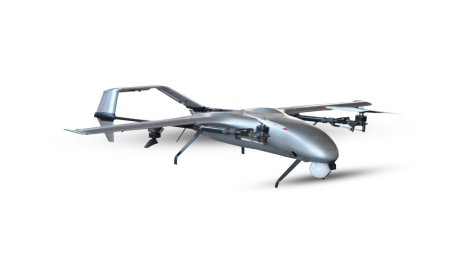
BLA2000XSERIES Electric Tilt-Rotor UAV for ISR Missions
Electric Tilt-Rotor UAV for ISR Missions
Introduction – General Description
The Electric Tilt-Rotor UAV is a high-tech remotely piloted aircraft designed for rapid deployment, easy portability, and maximum flexibility in any mission.
Its tilt-rotor configuration enables vertical take-off and landing (VTOL), while transitioning to fixed-wing flight ensures increased range, extended endurance, and higher mission speed.
Capable of carrying out a wide range of surveillance, reconnaissance, and intelligence-gathering (ISR) missions, this UAV is an ideal solution for both military and civilian applications.
Main Features
- Vertical Take-Off and Landing (VTOL) Capability: Enables rapid deployment and operational flexibility without the need for runways or infrastructure.
- Tilt-Rotor Design with Fixed-Wing Transition: Combines the precision and control of vertical flight with the efficiency of fixed-wing flight, maximizing endurance, range, and mission speed.
- Fully Electric Propulsion with LiPo Batteries: Offers silent operation, zero CO₂ emissions, a reduced environmental footprint, and low thermal signature—ideal for discreet operations.
- Lightweight Construction with Composite Materials (CFRP): High strength, low weight, and increased resistance to stress.
- Ease of Transport and Rapid Assembly: Compact foldable design for easy packaging, transport, and deployment in rugged environments.
- Advanced EO/IR Sensor: Supports day/night missions with real-time target detection and tracking capability.
- Modular Multi-Mission Payload Bay: Allows integration of various mission payloads (cameras, sensors, electro-optical systems).
- High Durability and Reliability: Designed to operate in adverse weather and demanding environments.
- Autonomous Flight Operation: Capable of executing automatic flight with flexible mission profiles.
Detailed Technical Characteristics
Structure and Construction
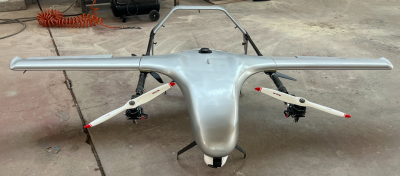
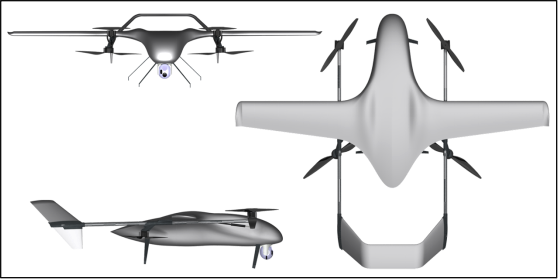
- UAV Type: Tilt-Rotor VTOL with fixed-wing
- Construction Material: Carbon Fiber Reinforced Polymer (CFRP) – composite for low weight and high strength
- Folding Capability: For easy transport and rapid assembly
Dimensions and Weight
- Length: ~2.5 meters
- Wingspan: ~3.0 meters
- Height: ~0.7 meters
- Maximum Take-Off Weight (MTOW): 37 kg
- Usable Payload Capacity: up to 5 kg
Propulsion System
- Type: Fully electric
- Batteries: High-capacity LiPo
- Propulsion Features: Silent operation, low thermal signature, environmentally friendly (zero CO₂ emissions)
Flight Performance
- Cruise Speed: 90 km/h
- Maximum Speed: 120 km/h
- Range: up to 100 km
- Flight Endurance: 1.5 hours
- Maximum Operational Altitude: up to 3000 meters
Systems and Functions
- Autonomous Flight: Automatic take-off, navigation, and landing via autopilot
- Sensors: EO/IR payload for day/night operations and target recognition
- Modular Payload Bay: Payload customization depending on mission (cameras, sensors, mission equipment)
Ruggedness and Environmental Operations
- Operation in Harsh Conditions: Designed for missions in difficult environments, including remote or inaccessible areas
- Environmental Compliance: Low acoustic footprint, zero emissions, environmentally friendly
Operational Applications
Military Applications
- ISR (Intelligence, Surveillance, Reconnaissance): Real-time target surveillance and recognition, tactical mission support
- Battlefield Reconnaissance and Damage Assessment (BDA): Documentation and evaluation of damage after attacks for command updates
- Security Support: Detection and tracking of suspicious activities in critical zones
Civil Protection
- Monitoring of Critical Infrastructure: Inspection of power grids, pipelines, transportation networks, and other sensitive areas
- Fire Prevention and Monitoring: Aerial imaging for early wildfire detection and spread monitoring
- Environmental Monitoring: Data collection on atmospheric, geological, and ecological parameters
Search and Rescue
- Rapid Deployment in Disaster Areas: Locating survivors, delivering first aid, and assessing affected areas
- Rescue Support: Visual and thermal surveillance to guide rescue teams in hard-to-reach locations
System Advantages
- Quick Deployment & Portability: Foldable design for immediate field readiness
- Vertical Take-Off and Landing (VTOL): Operates without the need for a runway
- Extended Endurance & Range: Thanks to the tilt-rotor configuration and fixed-wing transition
- Silent, Eco-Friendly Operation: Electric engine with zero emissions
- Mission Flexibility: Suitable for military, civil, and humanitarian operations
- Advanced Sensor Technology: EO/IR payload for day and night operations
- High Durability: Operates reliably under harsh weather conditions