
VTOL UAS με Θερμικό Κινητήρα
BLA3000XSERIES - VTOL Thermal Engine UAS
Unmanned Aerial Vehicle with Vertical Take-Off – Fixed-Wing Long-Endurance for Surveillance and Mission Support
Introduction – General Description
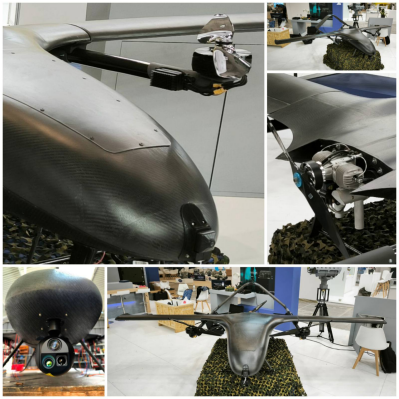
The Vertical Take-Off and Landing – Fixed-Wing Long-Endurance Unmanned Aerial Vehicle (UAV) is an advanced operational tool designed for wide-area surveillance, long-duration missions, and support of multiple operational scenarios. Its VTOL (Vertical Take-Off and Landing) capability combined with fixed-wing flight ensures maximum flexibility, operational autonomy, and long range, allowing deployment even in areas lacking airfield infrastructure. Equipped with a thermal propulsion pusher-type engine, the UAV offers extended flight duration, reduced refueling needs, and the ability to carry specialized payloads such as ISR sensors, surveillance systems, or light support material. Designed for rapid deployment and easy transport, the UAV can perform a wide range of surveillance, intelligence gathering, and support missions, making it an ideal solution for military, civil, and humanitarian operations over long distances and in challenging environments.
Main Features
- VTOL (Vertical Take-Off and Landing): Enables operational deployment without the need for a runway, even in constrained or infrastructure-limited areas.
- Fixed-Wing: Ensures higher aerodynamic efficiency, greater flight endurance, and mission range.
- Thermal Propulsion Engine (Pusher Type): Provides long flight time and higher cruise speed, making the UAV ideal for long-range missions.
- Payload Transport: Supports integration of mission payloads such as ISR sensors, EO/IR systems, or small support material packages.
- High Endurance and Range: Capable of remaining airborne for extended missions, covering large surveillance areas.
- Lightweight and Durable Structure: Constructed from advanced composite materials (CFRP) for low weight and high stress resistance.
- Rapid Deployment and Easy Transport: Designed for quick assembly, simple transport, and operation in remote areas.
- Advanced Sensor Systems: Equipped with EO/IR payloads for day/night monitoring, data collection, and real-time target identification.
Detailed Technical Characteristics
Structure and Build
- UAV Type: Vertical Take-Off (VTOL) – Fixed-Wing
- Construction Material: Composite materials (Carbon Fiber Reinforced Polymer – CFRP) for lightweight and strength
- Assembly Capability: Designed for easy transport, quick assembly, and field deployment
Dimensions and Weight
- Length: 2.9 meters
- Wingspan: 4.0 meters
- Height: 1.0 meter
- Maximum Take-Off Weight (MTOW): 55 kg
- Usable Payload: Configurable, up to 15 kg
Propulsion System
- Engine Type: Thermal internal combustion pusher engine
- Engine Displacement: 123 cc
- Engine Power: 11.5 hp
- Fuel: Gasoline
- Tank Capacity: 18 liters
Flight Performance
- Endurance: > 8 hours
- Range: > 1000 km (link-dependent)
- Cruise Speed: 100 km/h
- Maximum Speed: 140 km/h
- Max Operational Altitude: 3000 m
Payload Capability
Usable Payload: Configurable, suitable for ISR sensors, EO/IR systems, monitoring equipment, or small support loads (e.g., medical supplies, first-aid material)
Systems and Functions
- Autonomous Flight: Automated take-off, mission execution, and landing via autopilot
- Advanced Sensors: EO/IR payload for day/night operations, real-time target monitoring
- Modular Payload Bay: Easy payload reconfiguration based on mission requirements
Operational Applications
Military Applications
- Long-Duration ISR (Intelligence, Surveillance, Reconnaissance): Continuous wide-area monitoring, intelligence collection, and real-time target identification.
- Support in Low-Infrastructure Zones: Delivery of small support loads (medical supplies, equipment) to hard-to-reach areas.
- Battlefield Reconnaissance and Damage Assessment (BDA): Identification of destruction and assessment of damage in remote areas after military operations.
Civil Protection
- Monitoring of Critical Infrastructure: Pipelines, energy networks, transportation, and industrial facilities via long-endurance flight.
- Natural Disaster Prevention and Response: Early risk detection in large areas (e.g., wildfires, floods) through continuous surveillance.
- Emergency Response Support: Delivery of essential materials and equipment to remote communities.
Search and Rescue
- Large-Area Surveillance for Survivor Detection: Use of thermal sensors and EO/IR systems to locate individuals in emergency situations.
- Remote Area Rescue Support: Providing critical information to SAR teams and transporting small equipment or first-aid materials.
System Advantages
- Long Range and Endurance: Over 8 hours of continuous flight, covering distances depending on communication link, ideal for large-area surveillance.
- VTOL + Fixed-Wing Capability: Operates without a runway, deployable in inaccessible or remote areas.
- Thermal Pusher Engine (11.5 hp): Enables higher speed, reduced refueling needs, and increased resilience in extended missions.
- Payload Transport Capability: Supports specialized missions with equipment, sensors, or critical support material delivery.
- Advanced EO/IR Surveillance: Enables day/night monitoring, target identification, and real-time intelligence gathering.
- Ease of Transport and Deployment: Designed for quick assembly, simple packaging, and operational readiness.
- Operation in Harsh Environments: Rugged design suitable for adverse conditions, long-duration missions, and areas with limited infrastructure.
Technological Platform & Operational Architecture
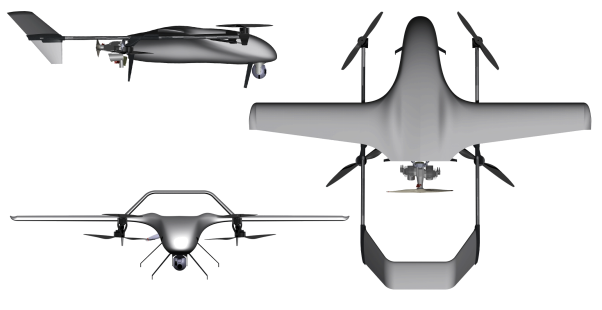
The VTOL UAS with a Thermal Engine is built on an advanced modular unmanned systems architecture, designed for long-endurance, long-range Intelligence, Surveillance, and Reconnaissance (ISR) missions.
The platform supports BVLOS (Beyond Visual Line of Sight) operations and a high-level navigation architecture, ensuring reliable operational performance in demanding environments and remote areas.
The combination of VTOL and fixed-wing design, along with efficient thermal propulsion, enables rapid deployment, extended endurance, and operational flexibility. The system’s modular philosophy allows for future adaptations and alternative propulsion and payload configurations in line with evolving mission requirements.